
Review · DENALI
Denali Peak Sightseeing by Plane
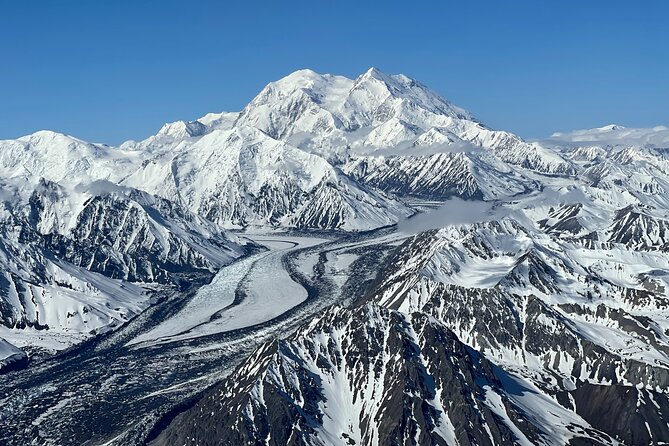
Denali is so large that the best way to understand it may be to leave the ground. From a small plane, you can look straight down on glaciers, ridge lines, climbing camps, and the huge white mass of North America’s highest peak. The flight lasts about an hour, but the scale of what you see stays with you much longer.
I like the window seat for every passenger, which removes the usual scramble for the best view. I also like the skilled narration from pilots such as Maggie, Bob, Chris, and Dan, who point out glaciers, climbers, rivers, and mountain routes while keeping an eye on both sides of the aircraft.
The main consideration is weather. Denali can be hidden by cloud even when the airstrip is clear, and the aircraft may encounter bumps along the route. You can have a superb flight without seeing the summit, so book this for the Alaska Range as a whole, not only for one perfect photograph.
Key points to know before booking
- Denali from a window seat: Every passenger gets a view from the small twin-engine aircraft, with wing turns to help both sides see the major sights.
- A private airstrip near the park: The airstrip sits about 8 miles south of Denali National Park’s road entrance, with hotel pickup included.
- Glaciers are a major feature: Expect views of the Ruth, Kahiltna, Muldrow, Traleika, Brooks, Tokositna, and Eldridge glaciers when conditions allow.
- Flight paths depend on weather: The route may focus on Denali’s north side, south side, or other parts of the Alaska Range.
- Skilled pilots add real value: Pilots including Maggie, Bob, Chris, Brian, and Dan provide commentary and help passengers understand what they are seeing.
- A costly but special excursion: At $487.15 per person, this is not a casual add-on, but it offers a view that a bus ride cannot match.
Why seeing Denali by air changes the whole park
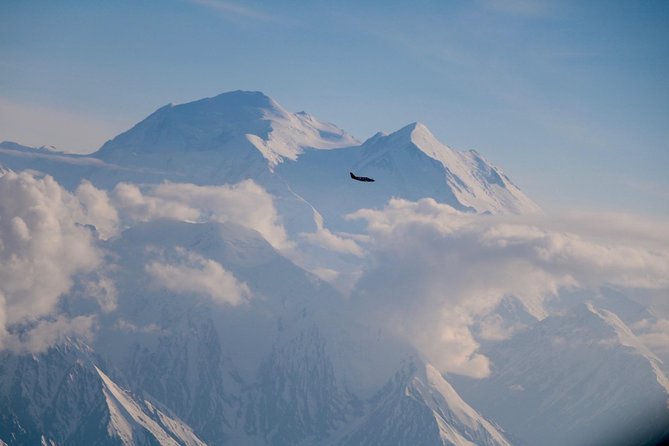
A road trip through Denali gives you a long, low view of the park. You see rivers, open valleys, wildlife, and mountain slopes from below. The plane gives you the missing piece: height.
From above, Denali National Park becomes easier to read. The Nenana River marks the eastern edge of the park, and shortly after takeoff you cross it on the way toward the Alaska Range. The six million acres spread out beneath you in broad bands of river valleys, colored ridges, snowfields, and rock.
The mountains are not simply tall. They are enormous in every direction. The flight helps you see how glaciers cut through the range and how isolated the peaks remain. I find this aerial view especially valuable because Denali can look distant from the park road, even on a clear day.
The aircraft also reaches places you cannot approach by road. You may see climbing routes, high camps, glacier tongues, and ridges used by early mountaineers. Those details give the mountain a human scale without making it feel tame.
Other park trips people book around the USA:
- Grand Canyon West, Hoover Dam Stop and Optional Lunch and Skywalk
★ 5.0 · 19,535 reviews - Grand Canyon West, Hoover Dam Stop, Breakfast, Lunch & Skywalk
★ 5.0 · 12,194 reviews - From Miami: Everglades Airboat, Wildlife Show & Bus Transfer
★ 4.2 · 8,622 reviews
From hotel pickup to the private airstrip
Your included shuttle pickup normally comes 30 to 60 minutes before flight time. The exact pickup depends on your hotel near Denali National Park, and driving time can change with traffic and the time of day.
The private airstrip is about 8 miles south of the park road entrance. This location matters because the operator says it can reach either side of the Alaska Range when weather blocks another approach. Denali itself is about 80 miles from the airstrip, so clear skies at the runway do not guarantee a clear summit.
At the office, you receive a passenger map briefing. This is a useful start, not just a formality. It helps you connect the route on the map with the ridges and glaciers you will see from the cabin.
Before boarding, the pilot gives a safety orientation. The aircraft is a comfortable twin-engine plane, and the maximum group size is 20 people. The actual aircraft may be smaller, as one recent flight used an 8-seat plane. Every passenger is placed by a window, which is one of the strongest practical features of the experience.
What the first minutes in the air feel like
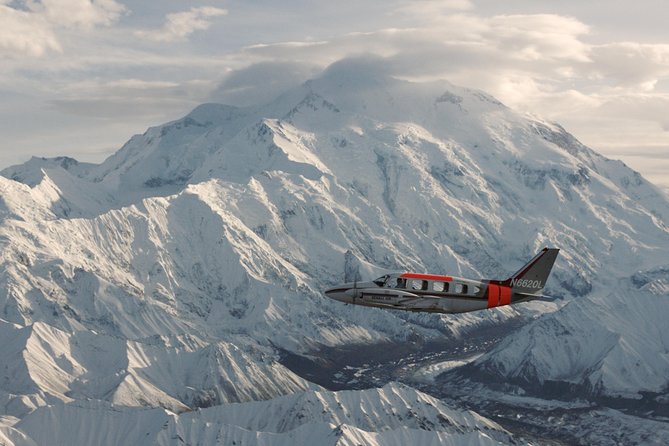
The aircraft crosses the Nenana River soon after departure. From there, the views open quickly, and the pilot begins identifying the features below.
Headsets let you hear the commentary clearly over the aircraft noise. That matters in a small plane, where it can be hard to follow spoken information without audio equipment. The pilots do more than name peaks. They explain the mountain routes, point out climbing camps during the climbing season, and call attention to glaciers and wildlife when visible.
Several pilots are praised for making the flight work for both sides of the cabin. Maggie is noted for making sure each side received a fair view, while other pilots used gentle wing turns to improve photo angles. You should still keep your camera ready, but you do not need to spend the whole flight worrying that you are sitting on the wrong side.
The ride can be smooth, but you should prepare for some movement. One passenger described a bumpy flight lasting much of the hour, while others had calm conditions above the clouds. Mountain air changes quickly, so even an experienced pilot cannot promise a perfectly steady ride.
The Wickersham Wall and Denali’s northern face
One of the most striking sights is the Wickersham Wall, a huge vertical face of ice and snow on Denali’s north side. The wall rises roughly 14,000 feet and gives you a powerful sense of the mountain’s height.
A road or bus view rarely communicates this kind of vertical relief. From the air, you can see the wall dropping away from the summit area, with glaciers gathering and flowing below. It is the kind of feature that makes a photograph useful but inadequate.
The north side also includes views toward the Traleika, Brooks, and Muldrow glaciers. The Muldrow flows from the area between Denali’s north and south summits at about 17,000 feet. These ice routes help explain how the mountain drains and how climbers move through the range.
If the summit is covered, the northern face can still make the flight worthwhile. The mountain’s structure, glaciers, and sheer walls remain impressive even when the highest point disappears into cloud.
Same park country, a different day out:
- Miami: Everglades National Park Airboat Tour & Wildlife Show
★ 4.5 · 7,296 reviews - Grand Canyon West Bus Tour with Hoover Dam and Optional Skywalk
★ 4.0 · 7,224 reviews - Clear Kayak Tour of Shell Key Preserve and Tampa Bay Area
★ 5.0 · 5,800 reviews - Vegas: Grand Canyon, Hoover Dam, Lunch/Skywalk Options, WiFi
★ 4.6 · 5,521 reviews
Ridges, climbing routes, and the south-side glaciers
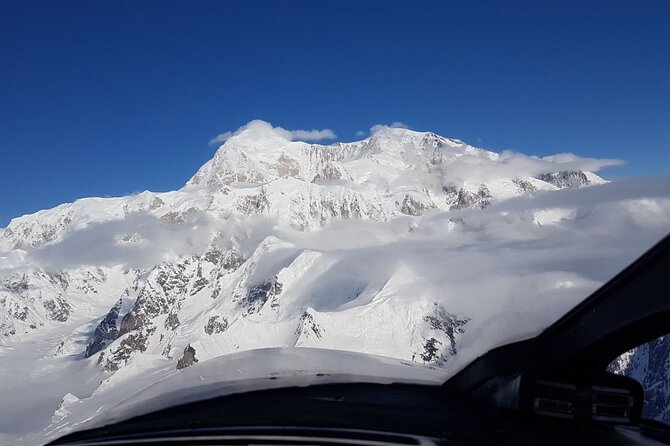
As the aircraft moves along the range, the pilot may cross the Carpe and Karstens ridges. These ridges are tied to the first successful climbs of Denali and offer a view of the mountain as a series of steep, connected routes rather than one isolated peak.
On the south side, the flight may include the Ruth Glacier, the Kahiltna Glacier, the Tokositna Glacier, and the Eldridge Glacier. The Ruth is known for its great depth, while the Kahiltna is the longest glacier in the Alaska Range. From the aircraft, you can see the difference between a broad glacier system and a narrow ice flow dropping between ridges.
During climbing season, the pilot may point out routes and camps at different elevations. This turns the white slopes into something more understandable. You may spot climbers acclimating or moving toward higher ground, though exact sightings depend on the season, route, and visibility.
One of the most useful parts of the narration is the way pilots connect these details. A good pilot does not simply point and move on. Dan, for example, was praised for combining strong storytelling with clear explanations, while Chris was noted for keeping the flight safe and well organized.
The Ruth Amphitheater and the Great Gorge
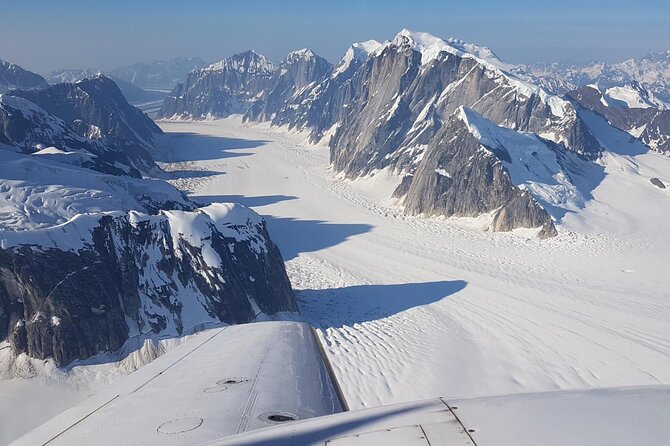
The Ruth Amphitheater is one of the most dramatic sections of the flight. Its granite walls rise about 5,000 feet above glacial ice, and the ice below can be nearly 4,000 feet thick.
This is where the aerial perspective is especially important. From the ground, you may see the mountains as walls on the horizon. From above, you see the amphitheater’s shape, the routes through it, and the relationship between rock and ice.
The Great Gorge adds another sense of scale. It is not simply a pretty glacier view. It shows the force of ice moving through solid mountain, cutting a route that is far too large to grasp from one viewpoint on the ground.
You will want a camera, but try to spend at least part of the flight looking without it. The aircraft may give you only a short stretch of clear viewing before cloud or a turn changes the scene.
Mount Foraker and the Denali family
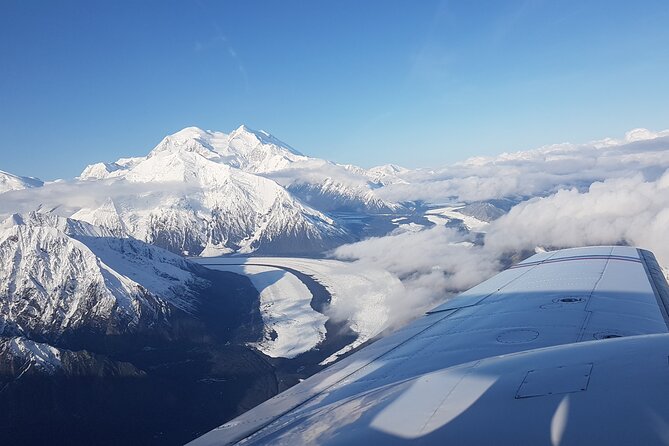
Denali gets the attention, but the surrounding peaks complete the picture. The flight may include Mount Foraker, Mount Russell, and Mount Hunter, the next three tallest mountains in the Alaska Range.
Seeing these peaks together helps you understand that Denali is part of a huge mountain system, not a solitary landmark. Mount Foraker in particular adds depth to photographs and makes the range feel broader than the name Denali suggests.
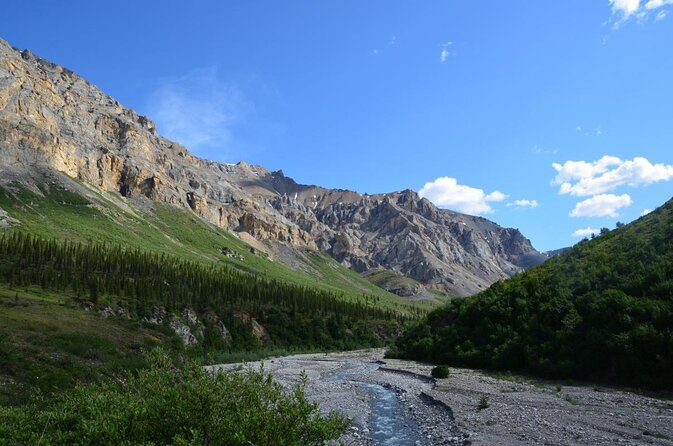
The route can also include the Polychrome Mountains and the Toklat River basin. Their colors and shapes contrast with the white high peaks. These lower features are important because they show the full range of the park, from river valleys and rounded ridges to ice-covered summits.
The exact route is set by weather and flying conditions. You may get a close look at Denali, a longer run over glaciers, or a broader circuit through the park. The operator says decisions about mountain weather are made close to departure, with updated information available by phone.
How the price compares with the experience
The price is $487.15 per person. That is a serious expense, especially for a family or group, and I would not describe it as a budget activity.
The value comes from access. A park bus can show you wildlife and the road corridor, but it cannot take you over the Wickersham Wall, the Ruth Amphitheater, or the high climbing routes. The flight also covers a great deal of ground in about an hour, with hotel transport, headsets, pilot commentary, taxes, and fees included.
I would compare it with the cost of adding several separate activities, not with the price of a short scenic ride. If Denali is the main reason you came to Alaska, the flight may be the most efficient way to see the mountain at close range.
The value is less certain if your budget is tight or if you need a guaranteed summit view. Weather can prevent the ideal route, and one flight cannot promise clear conditions at an 80-mile-distant mountain. Still, the broader Alaska Range remains part of the experience, and several excellent flights have taken place even when Denali itself was hidden.
Weather, motion, and the practical limits
Weather is the one issue you should take seriously. The experience requires good conditions, and poor weather can lead to a new date or a full refund. The operator may not make a final decision until about an hour before the flight, so be ready for a late change.
Do not judge mountain visibility only by conditions at your hotel. The airstrip, the route, and Denali can all have different weather at the same time.
Motion sickness and fear of flying also deserve honest attention. Some flights are smooth, while others include noticeable up-and-down and side-to-side movement. If you know small aircraft make you uneasy, this is not the place to ignore that concern.
The safety focus receives strong praise, and the pilots are experienced at operating in mountain conditions. Still, confidence in the crew cannot remove turbulence. Sit by your window, listen to the headset, and keep your attention on the view rather than trying to photograph every second.
After landing, you can take pictures of the plane and with the pilot. There is also time to discuss the route before the shuttle returns you to your hotel. That small pause is useful because the flight can pass quickly, especially on a clear day.
Who will get the most from this flight
I would choose this for anyone who wants to understand Denali’s scale rather than simply check off a summit view. It is particularly well suited to photographers, mountain lovers, families with older children, and anyone with limited time in the park.
It also works well as a complement to a ground-based park visit. The bus shows you the lower country, rivers, and wildlife. The plane shows you the high country and the shape of the range.
You should think twice if you have a strong fear of small planes, severe motion sensitivity, or a strict budget. You should also leave room in your schedule if possible, since weather may affect departure or require a change of date.
Free cancellation is available up to 24 hours before the start time for a full refund. Changes or cancellations inside that window are not accepted, except that weather or minimum group cancellations lead to a different date, another experience, or a full refund.
Should you book Denali Peak Sightseeing by Plane?
I would book it if Denali is a central part of your Alaska trip and $487.15 fits your budget. The combination of window seating, hotel pickup, pilot narration, and access to glaciers and climbing routes gives you a view that no road excursion can reproduce.
Book with realistic expectations. The summit may be hidden, the ride may be bumpy, and the exact route will change with weather. If you can accept those limits, this flight offers one of the clearest ways to grasp the scale of Denali National Park and the Alaska Range.
FAQ
How long does Denali Peak Sightseeing by Plane last?
The experience lasts approximately 1 hour to 1 hour 10 minutes. Hotel pickup takes place about 30 to 60 minutes before the scheduled flight, depending on your hotel location.
Is hotel transportation included?
Yes. Round-trip shuttle transportation from hotels near Denali National Park is included. The flight departs from a private airstrip about 8 miles south of the park road entrance.
Does every passenger get a window seat?
Yes. Passengers are seated by a window in the aircraft, allowing everyone a chance to see the scenery and take photographs.
Will I definitely see the summit of Denali?
No. The exact route and views depend on weather. Denali can have different conditions from the airstrip, and the summit may be hidden even when the flight area is clear.
What can I see during the flight?
Depending on conditions, you may see Denali, the Wickersham Wall, several glaciers, the Ruth Amphitheater, Mount Foraker, Mount Hunter, Mount Russell, the Polychrome Mountains, the Toklat River basin, climbing routes, and high camps.
Are headsets provided?
Yes. Headsets are provided so you can hear the pilot or guide commentary during the flight.
What is the cancellation policy?
You can cancel up to 24 hours before the start time for a full refund. Cancellations or changes made less than 24 hours before the start time are not accepted. If poor weather or an insufficient number of passengers causes the operator to cancel, you will be offered a different date or experience, or a full refund.
Just added around the USA
- Yosemite National Park Self Guided Driving Audio Tour Guide★ 4.5 · 47 reviews
- Self-Guided Audio Driving Tour in Sequoia and Kings Canyon★ 4.5 · 29 reviews
- Bryce Canyon National Park Self-Guided Driving Audio Tour★ 4.5 · 71 reviews
- Bryce Canyon Hiking Challenge★ 5.0 · 92 reviews
- Bryce Canyon E-bike Tour★ 5.0 · 147 reviews
- Yellowstone Winter Wildlife Safari from Bozeman★ 5.0 · 42 reviews
- Private Yellowstone Winter Wolf Watching and Wildlife Safari★ 5.0 · 26 reviews
- Yellowstone Wildlife Safari from Bozeman – Private Tour★ 5.0 · 140 reviews
Denali National Park Tours, compared.

Browse the lists this tour appears in